NovArk Power 2000 kW ESP Diesel Generator Set Entered Hunan's First-Set Major Technical Equipment List
- Share
- publisher
- NovArk Power
- Issue Time
- Nov 8,2026
Summary
NovArk Power's 2000 kW ESP emergency standby diesel generator set passed expert review and entered Hunan's first-set major technical equipment public list. What the provincial assessment evaluates, what the ESP duty rating actually means, and where that evidence ends for a given project.
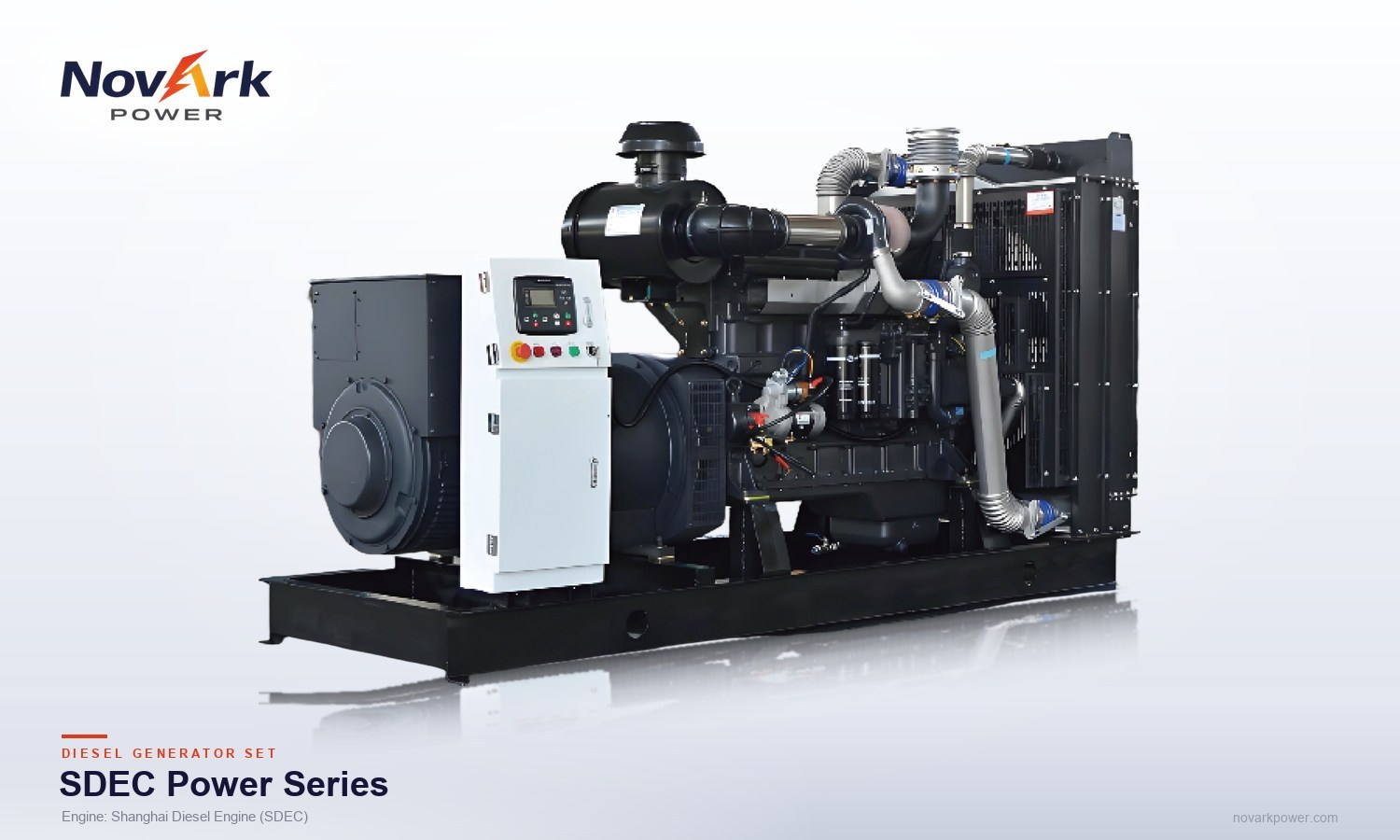
The Hunan Provincial Department of Industry and Information Technology has published its public notice: the NovArk Power 2000 kW ESP emergency standby diesel generator set passed expert review and entered the province's list of first-set major technical equipment.
First-set (shou tai tao) recognition is the province's assessment of innovative equipment from local manufacturers. It weighs technical innovation, advancement and reliability, and asks whether a product has reached an advanced provincial standard in technical indicators, domestic supporting content and industrialisation capability.
For a buyer outside China, the useful question is not what the certificate looks like on a wall. It is what the review actually checked, what an ESP rating commits a supplier to, and where that evidence stops being relevant to your own site.
What the first-set listing evaluates
The assessment is not a marketing award. It evaluates a single model on three things buyers also care about: whether the design is genuinely new, whether its indicators are advanced for its class, and whether the unit can be built and supported at industrial scale. "Domestic supporting content" asks how much of the set rests on a local supply chain rather than imported sub-assemblies; "industrialisation capability" asks whether the design can be manufactured repeatedly to the same standard, not proven once in a workshop.
That is a different question from the one a project engineer asks. A provincial list says a model survived a technical review by people who compare equipment for a living. It does not say the set will start at -20 °C on your site, carry your largest motor, or satisfy the emission rules at your port of discharge.
What "2000 kW ESP" actually specifies
ESP stands for emergency standby power. It is a duty rating, not a description of size, and confusing it with prime power is one of the most expensive mistakes in standby procurement. Under the ISO 8528 framework most export projects are written against:
| Rating | Duty | What it commits the supplier to |
|---|---|---|
| ESP | Emergency standby | Capacity for the duration of a grid failure, at a declared load factor, with no overload allowance |
| PRP | Prime power | Variable load over unlimited hours, with a 10% overload for one hour in twelve |
| COP | Continuous | Steady load over long periods, at a constant declared output |
An ESP-rated set is built to cover an outage, not to be your power station. Running one as a permanent prime source does not fail immediately; it shortens the interval between overhauls and moves the failure into the warranty argument.
A 2000 kW ESP set is sized for the moment mains supply disappears and a facility has to carry its critical load. The advantages cited for this unit match that duty: fast start response, strong load-taking capability, stable operation and wide adaptability. Those are design intentions, not measured figures, so ask for the declared load factor, the starting conditions and the test report before you compare prices.
The first minute: what a standby set must actually do
Buyers compare rated power; operators care about the first sixty seconds. The set has to accept the automatic start signal, reach voltage and frequency, and let the transfer switch move the load - with the gap bridged by whatever the facility has, a UPS, a DC bus, or nothing at all.
Then the load arrives, and this is where undersized units fail. Pumps, compressors, crushers and chillers draw several times their running current for the first moments after start. Block load acceptance depends on the engine's torque reserve, the alternator's reactances and the excitation system, and it is a declared figure rather than a universal one. Check it against your largest starting duty, not against total connected load.
After that the governor has to hold frequency while loads switch in and out. On a 2 MW set feeding a production line, a badly matched control system shows up as flickering lighting, tripped drives and complaints from the shop floor - not as a spectacular failure.
Sizing an emergency standby set: four inputs that decide it
Most sizing errors come from adding up nameplate ratings. Four inputs do the real work:
- 01
The critical load list
What must stay energised, at what power factor, and what can be shed. A precise list beats a generous total.
- 02
The largest starting duty
The biggest motor, its starting method and its starting current. Direct-on-line, star-delta, soft starter and VFD place very different demands on the set.
- 03
The tolerable voltage dip
What the rest of the plant can survive while that motor starts. This sets the ceiling, not the generator nameplate.
- 04
Site conditions and duty
Altitude, ambient temperature, enclosure, hours per year, and whether the set must parallel with the grid or another unit.
With those four inputs a load study can be run and a defensible rating recommended. Sizing practice across the wider range is covered in the diesel generator buying guide.
Where a 2 MW emergency set is specified
High-power emergency units cluster where an outage is measured in money rather than inconvenience.
Computing and data halls
Short bridging times, tight voltage windows, and a load that steps rather than ramps. See the computing power centre solution.
Hospitals and laboratories
Life-safety loads on a separate bus and imaging equipment with high inrush. See the medical power solution.
Telecom and remote sites
Unattended operation, remote monitoring, and fuel logistics that decide how long a site stays up. See the communication power solution.
Industry and infrastructure
Motor-heavy loads, process restart sequences, and the cost of a scrapped batch when power drops mid-cycle.
Engine platforms across the range
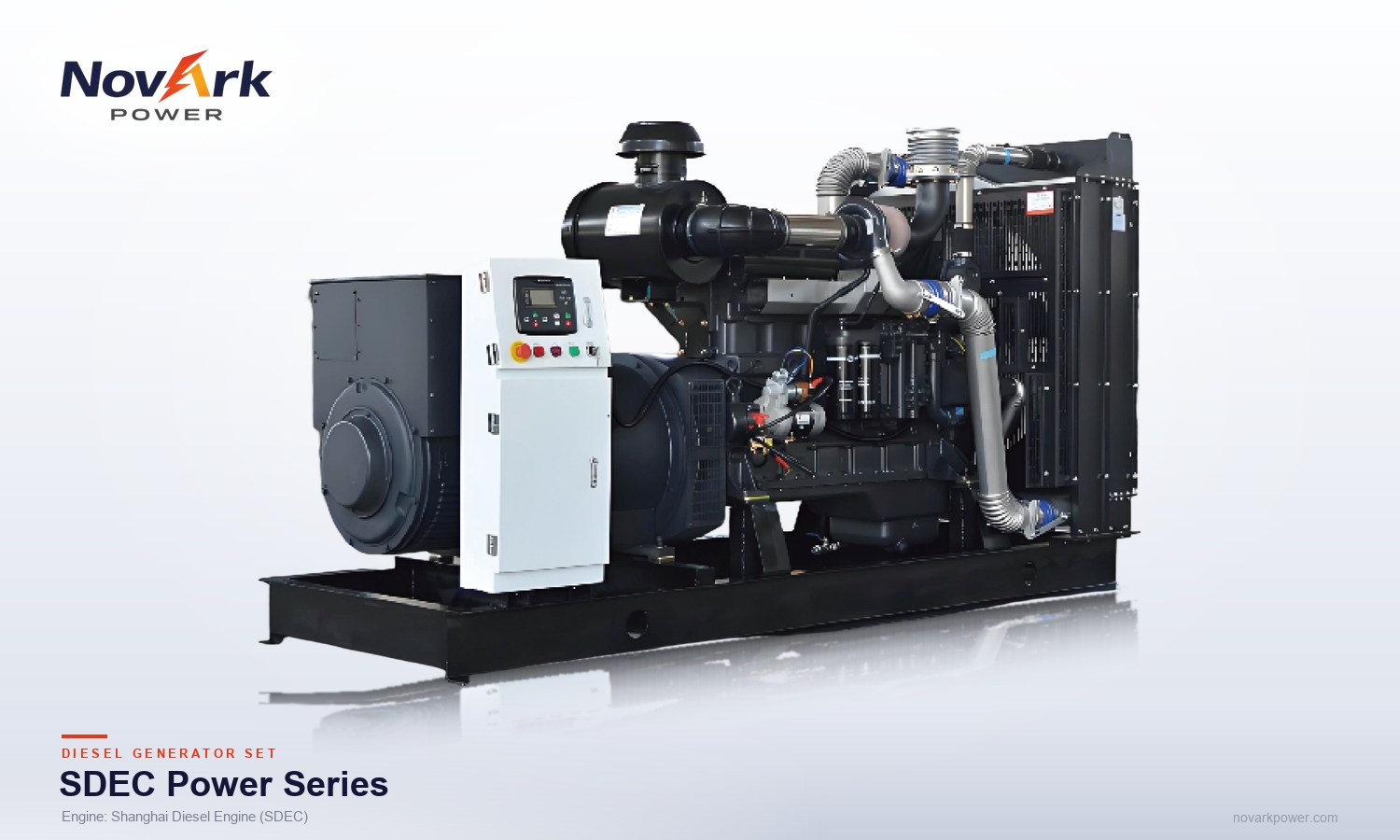
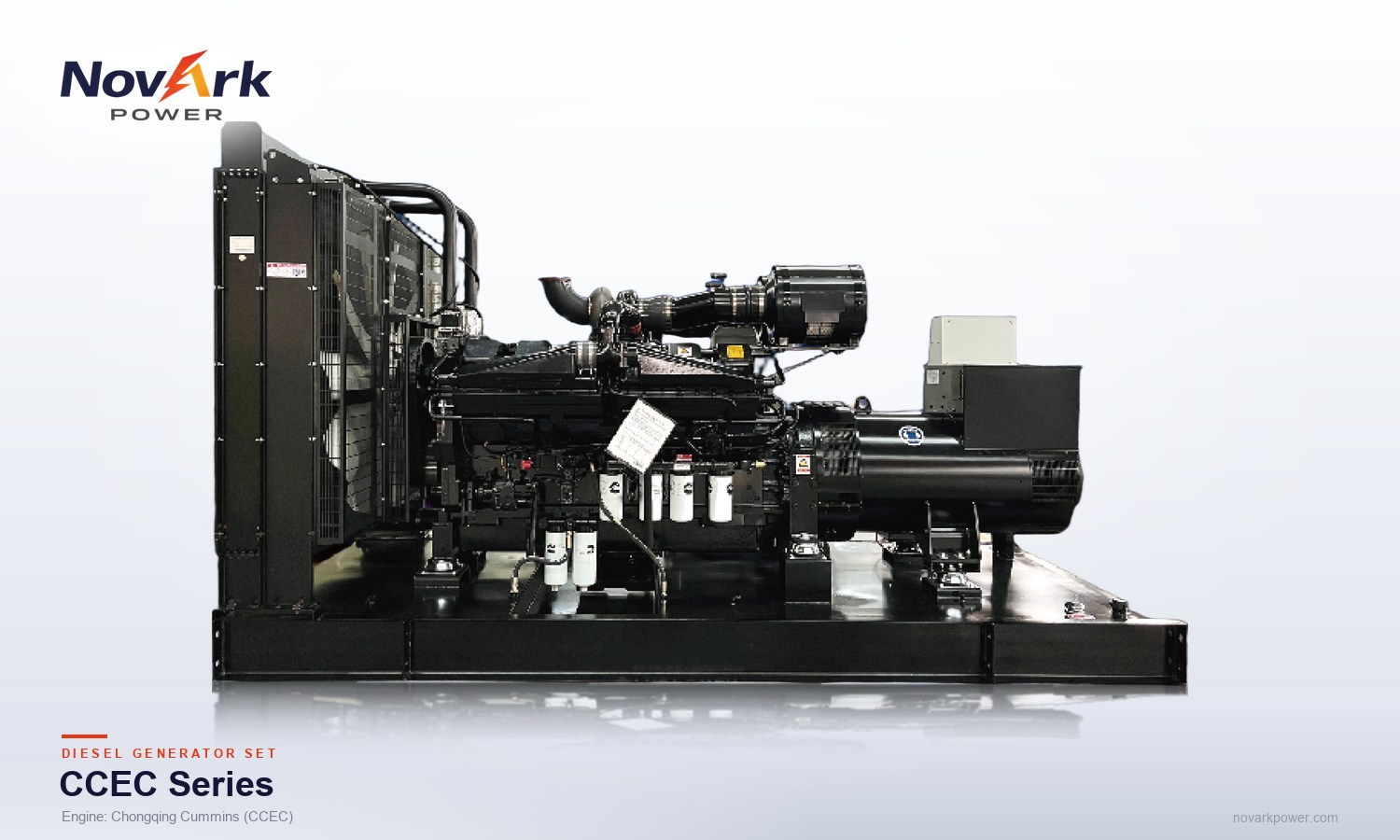
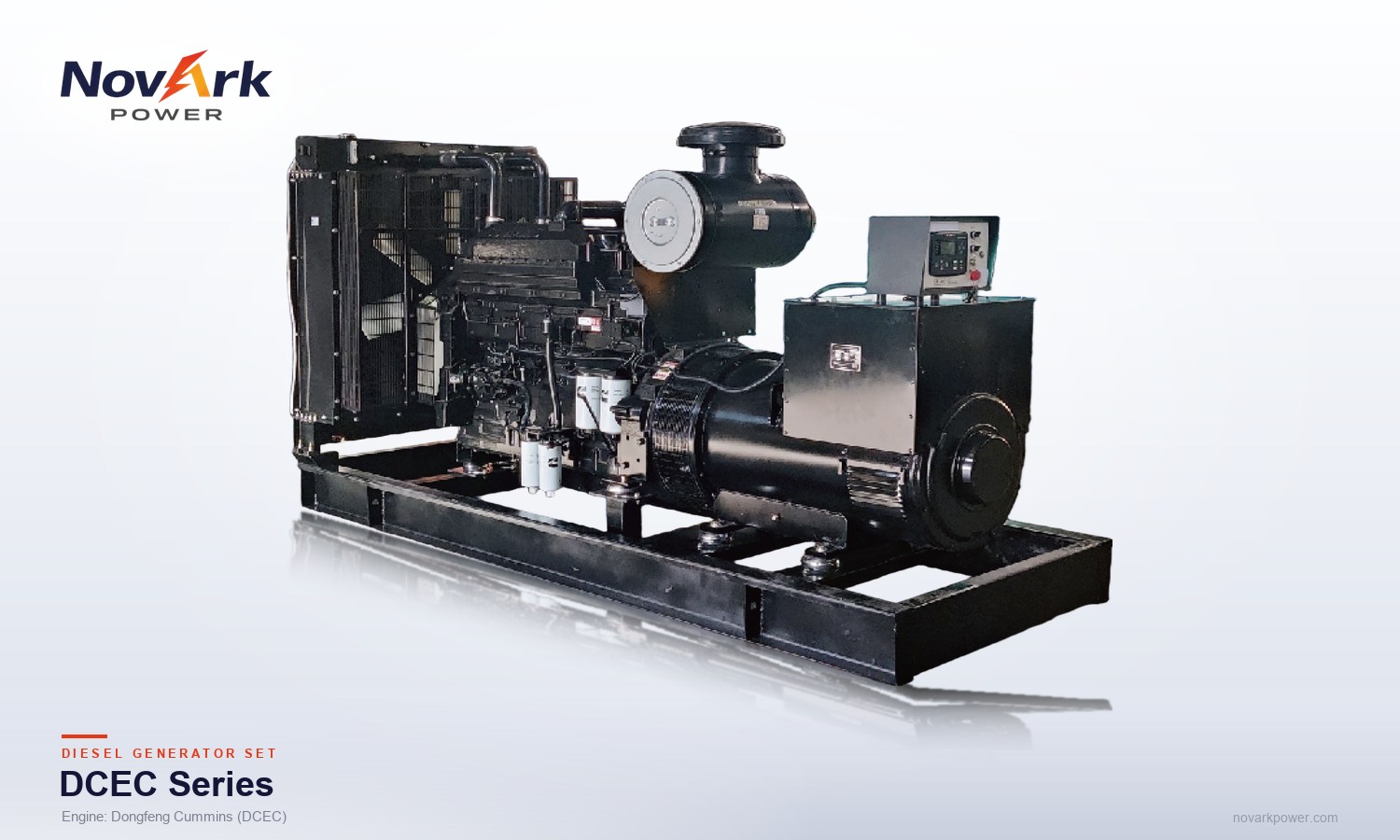
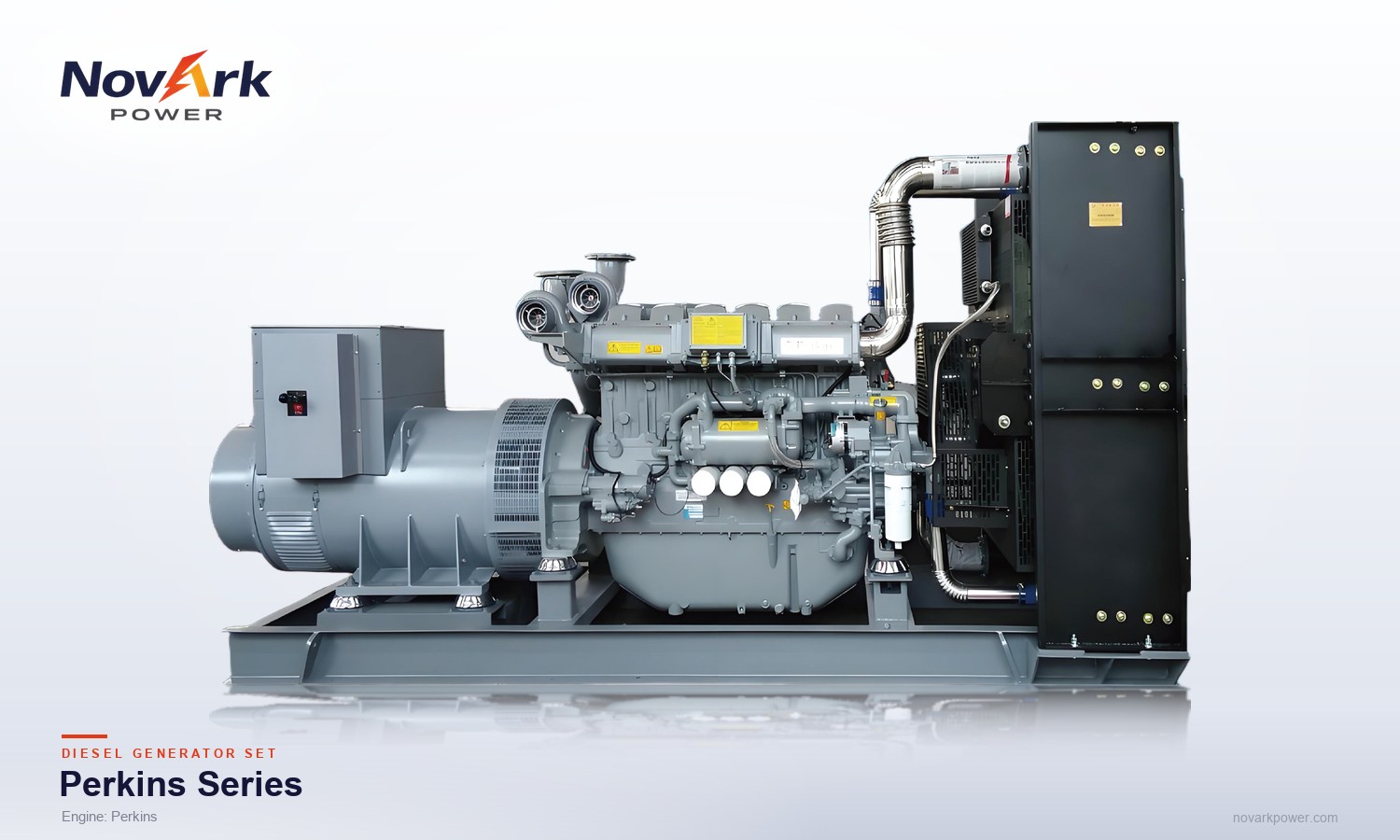
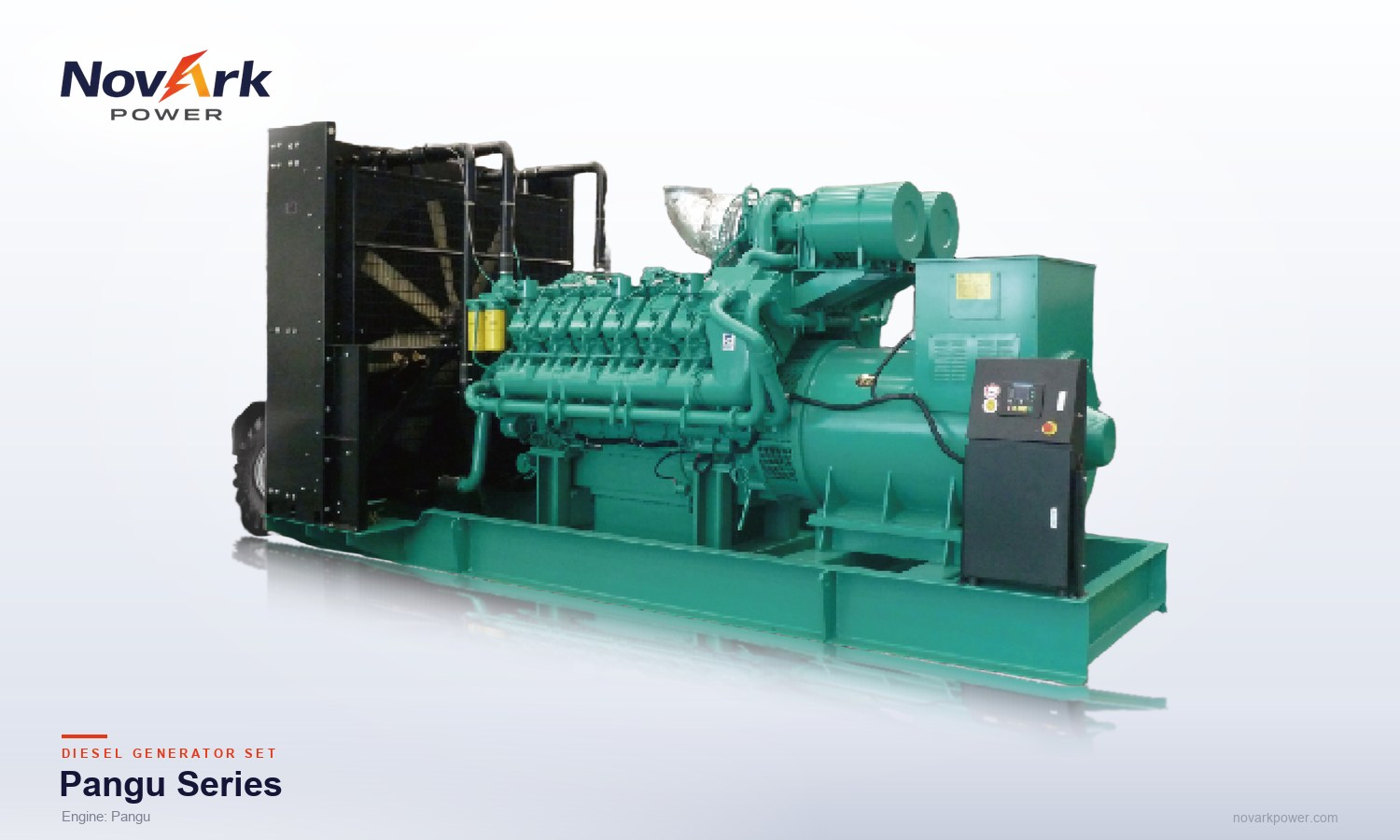
High-power emergency sets are configured around engine platforms rather than one fixed model. Across the range NovArk Power builds on SDEC, CCEC (Chongqing Cummins), DCEC (Dongfeng Cummins), Perkins and Pangu platforms, with the final choice driven by rating, load profile and the service network at the destination. Actual availability is confirmed against the current catalogue.
Site planning for a 2 MW set
Fuel. A day of autonomy at this size means a tank measured in tens of cubic metres, so location, bunding, fire separation and truck access belong in the early layout. Fuel grade must match the coldest ambient the site will see.
Cooling and combustion air. The radiator rejects a large amount of heat into the room. Ventilation openings and duct routing are sized against the set's heat rejection data, not against habit - a room that suited a 500 kW unit will cook a 2 MW one.
Exhaust and noise. Silencer selection, wall penetrations and stack height set both the noise at the boundary and the back pressure the engine sees. Over-restricting exhaust to buy a few decibels costs power and raises exhaust temperature.
Foundation and service space. Vibration isolation, baseframe anchorage and the clearance to pull a radiator core are cheaper to design in than to retrofit once the walls are up.
What the listing changes for buyers
For NovArk Power the listing strengthens its position in high-power emergency equipment and provides a qualification and credit reference for tenders, market development and supporting cooperation. That is what first-set recognition is worth commercially: a third-party technical review a procurement team can point to.
Read it as a reference point, not a specification. Provincial recognition confirms a model was reviewed on innovation, advancement and reliability. It does not state that a set will start at a given ambient temperature, carry a given load step, or meet a given site's emission rules. Those belong in the approved technical documents for your project.
Documents to request before you sign
- The rating declaration: ESP, PRP or COP, with the load factor attached
- Block load acceptance and the voltage dip it implies
- Alternator data sheet with reactances and excitation type
- Fuel consumption curve across the load range
- Heat rejection and combustion air figures
- Dimensions, weight and centre of gravity for transport
- Factory test report, including any witnessed load test
- Warranty scope, service response and spare parts list
Frequently asked questions
Is a 2000 kW ESP set the same as a 2000 kW prime rated set?
No. The kW figure can be identical while the duty is not. An ESP set is declared for standby with no overload allowance; a PRP set is declared for variable load over unlimited hours. If the set will carry the plant every day, specify PRP.
Can an ESP set run continuously if I keep the load low?
It can run, but it is not declared for that duty. Running hours and maintenance intervals are written around the standby assumption. For daily operation, take the prime rating instead of derating a standby unit.
How much fuel does a 2 MW set use?
Consumption follows the load, not the nameplate, so a set at half load uses far less than one at full output. Ask for the consumption curve and calculate autonomy from expected average load.
What certification should an overseas buyer ask for?
Start with the documents the destination requires - emission rules, electrical code, port clearance - then add the factory test report. A provincial listing is a useful reference point, not a substitute for the compliance file your authority will ask to see.
What comes next
The company will keep developing high-power emergency equipment, focused on product performance and on complete supply systems rather than single units.
If you are specifying a standby set, send the critical load list, the largest motor data, the acceptable voltage dip and the ambient conditions through our contact page. The conversation starts from the load, not from a catalogue page. For units already in service, the FAQ section covers maintenance and selection.
Reliable Power for Your Factory and Every Project.
Note. The first-set list is published by the Hunan MIIT and was at public notice stage at the time of writing. Ratings, configurations and performance figures are confirmed in the approved technical documents for each project. ESP, PRP and COP are used here in their ISO 8528 sense.